Introduction
As AI workloads drive higher rack densities and increasingly sophisticated liquid-cooling architectures, the Secondary Fluid Network (SFN) has become an important part of the cooling infrastructure.
But a reliable SFN is not created simply by selecting the right pipe, fitting, or manifold.
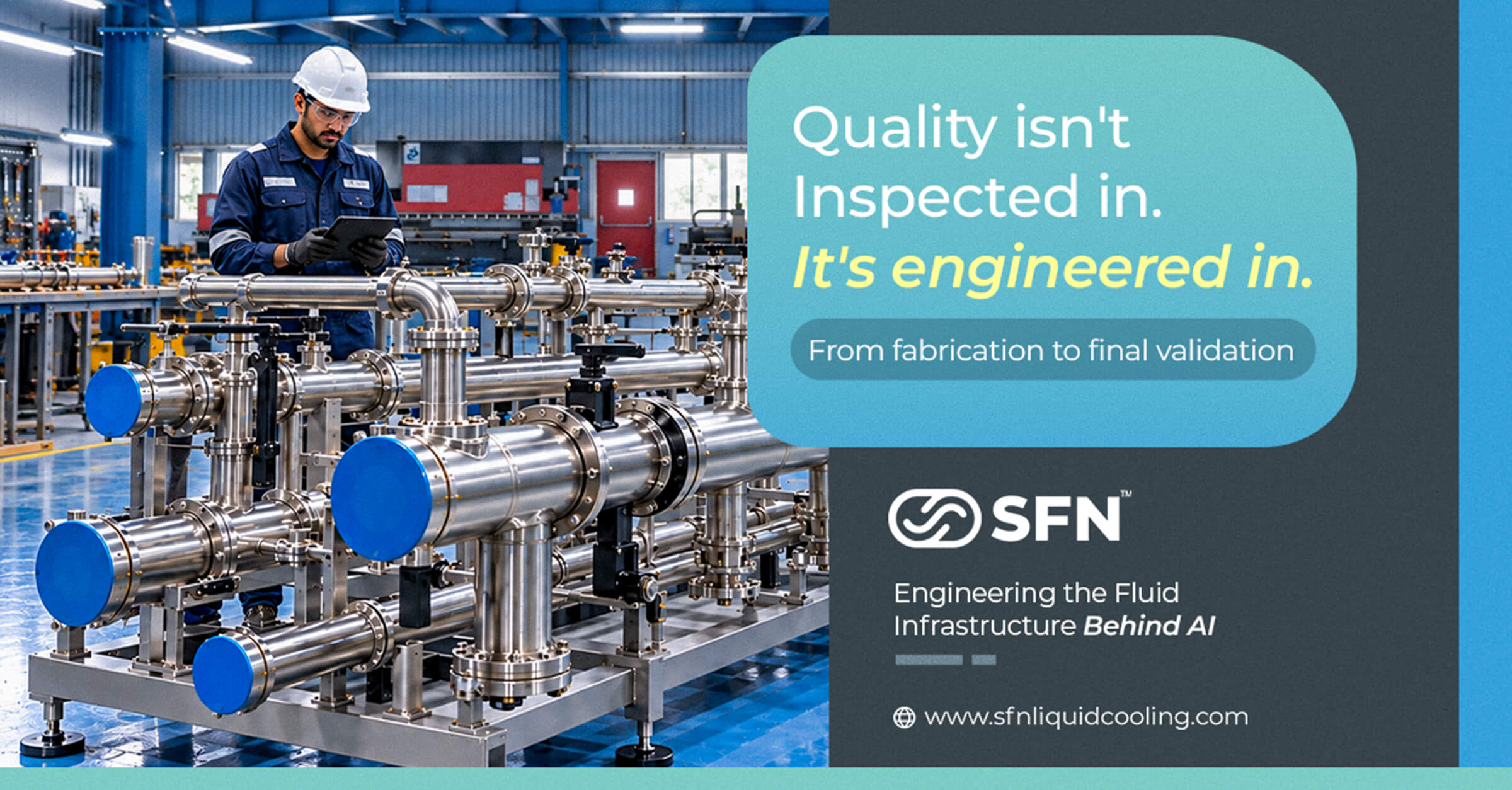
Reliability begins with the way the system is engineered, fabricated, inspected, tested, cleaned and prepared for deployment.
For this reason, quality needs to be built into every stage of the SFN lifecycle rather than treated as a final inspection activity.
- Quality Starts Before Fabrication
Before fabrication begins, engineering requirements, material specifications, dimensional requirements, and fabrication procedures need to be clearly defined.
A structured quality approach establishes checkpoints throughout the process so that potential issues can be identified before they progress to subsequent stages.
This creates a controlled path from:
Engineering → Fabrication → Inspection → Testing → Validation → Delivery
- Fabrication Quality and Process Control
Precision fabrication plays an important role in SFN reliability.
Pipe cutting, fit-up, welding, assembly and dimensional control need to follow defined procedures and inspection requirements.
Key controls can include:
- Dimensional verification
- Alignment checks
- Weld documentation
- Weld traceability
- Fabrication inspection
- Assembly verification
These controls help maintain consistency across individual components and complete assemblies.
- Weld Traceability and Documentation
Welding is a critical stage in stainless-steel SFN fabrication.
Documented welding practices and traceability help establish a record of how individual joints were fabricated and inspected.
This provides an important quality trail from the fabricated assembly back to the applicable manufacturing and inspection records.
- Dimensional & Alignment Verification
An SFN assembly must integrate correctly with the surrounding cooling infrastructure.
Dimensional and alignment checks help verify that fabricated assemblies conform to the required design dimensions and connection points.
This becomes particularly important for:
- Manifolds
- Headers
- Pipe assemblies
- Rack-level distribution systems
- CDU connections
Accurate fabrication can help reduce installation adjustments and integration challenges during deployment.
- Pressure and Leak Testing
Before an SFN assembly reaches commissioning, pressure and leak testing provide an important validation step.
Testing helps verify the integrity of the fabricated piping system and identify potential leakage or pressure-related issues before integration into the operating environment.
The specific testing methodology and acceptance criteria should be established according to the applicable engineering requirements and project specifications.
- Cleanliness Validation
For liquid-cooling infrastructure, cleanliness is another important quality consideration.
SFN quality processes can include controlled flushing and cleanliness validation activities such as:
- Flushing-flow documentation
- Turbidity monitoring
- pH verification, where applicable
- Contamination-control procedures
The objective is to ensure that the fluid distribution infrastructure is appropriately prepared before integration with the liquid-cooling system.
- Protection During Handling and Delivery
Quality control does not stop when fabrication is completed.
After testing and cleaning, assemblies need to remain protected during:
Handling → Packaging → Transportation → Site Installation
Measures such as sealed pipe ends and controlled packaging help reduce the risk of contamination entering the system after final cleaning and validation.
- Quality Is a Process, Not a Final Inspection
The reliability of an SFN is influenced by numerous activities performed throughout its lifecycle.
A robust quality approach therefore follows a series of defined gates:
ENGINEER
Define requirements
↓
FABRICATE
Build according to controlled processes
↓
INSPECT
Verify dimensions, welds and assembly
↓
TEST
Validate pressure and leak integrity
↓
CLEAN
Control and validate cleanliness
↓
PROTECT
Prevent contamination during delivery
↓
VALIDATE
Complete documentation and final quality checks
Conclusion
As liquid cooling becomes increasingly important for high-density AI data centers, the supporting fluid infrastructure must be engineered with the same attention to reliability as the cooling equipment itself.
For an SFN, quality is not a single inspection performed at the end of fabrication.
It is a continuous process built into engineering, fabrication, inspection, testing, cleaning, protection, and final validation.
That is the foundation of a controlled and deployment-ready Secondary Fluid Network.