
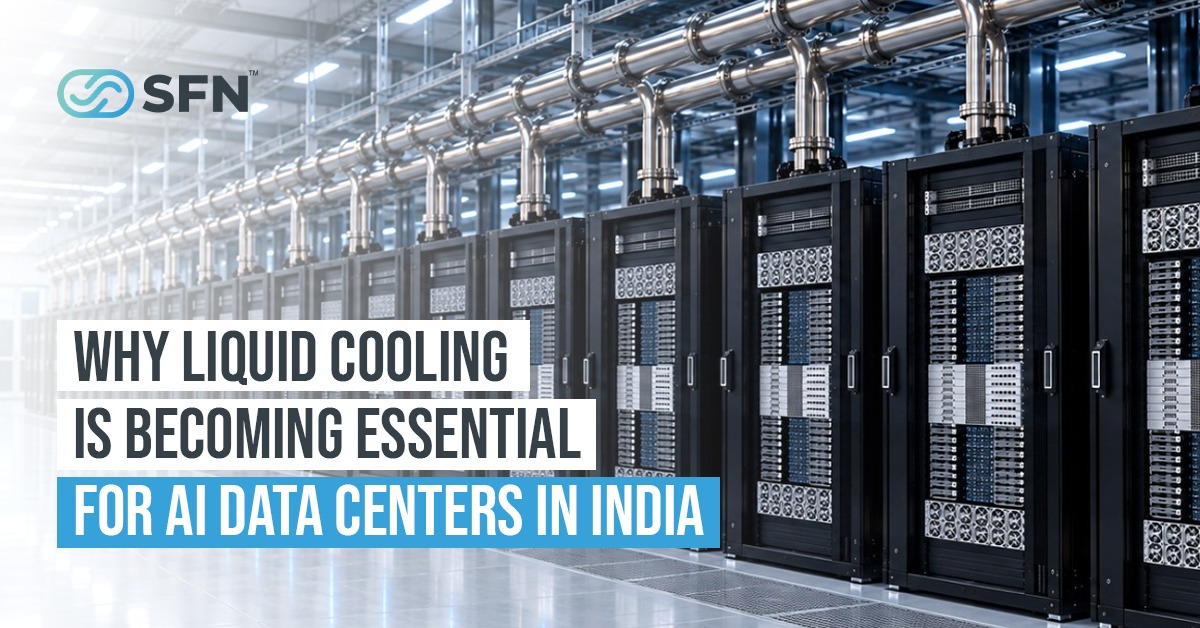
The rapid adoption of Artificial Intelligence (AI), high-performance computing (HPC), and GPU-intensive workloads is fundamentally changing the requirements of modern data centers. As computing power increases, so does the amount of heat generated by high-density server environments.
Traditional air-cooling systems, which have supported data centers for decades, are increasingly reaching their practical limits. This is driving a significant industry shift toward liquid cooling as a more efficient and scalable approach to thermal management.
According to Apurva Shah, Executive Director – Technical, Manufacturing & Projects at SFN Solutions, AI and GPU-dense racks are creating heat loads that conventional air-cooling systems were not designed to handle.
The Growing Need for Advanced Data Center Cooling
Modern AI infrastructure requires significantly higher computing density within the same physical footprint. GPUs can generate substantial thermal loads, making efficient heat removal a critical infrastructure requirement.
Air cooling alone can struggle to manage the thermal density, precise temperature requirements, and operational demands of high-performance AI clusters. As rack densities increase, data center operators need cooling technologies capable of delivering consistent thermal performance while supporting efficiency and scalability.
This is where direct-to-chip and hybrid liquid cooling architectures are becoming increasingly relevant.
Liquid cooling allows heat to be captured closer to high-temperature components, providing more precise and efficient thermal management than relying entirely on ambient air movement.
Why the Industry Is Moving Toward Liquid Cooling?
The shift toward liquid cooling is not simply about managing higher temperatures. It is also about improving the overall efficiency, reliability, and scalability of AI-ready data center infrastructure.
Liquid cooling can provide several important advantages:
- Support for higher rack power densities
- Improved thermal management
- More efficient heat removal
- Reduced cooling energy requirements
- Better suitability for AI and GPU-intensive workloads
- Greater scalability for future infrastructure expansion
As AI workloads continue to grow, cooling is becoming an integral part of data center architecture rather than simply a facility-level support system.
The Critical Role of Secondary Fluid Networks
While liquid cooling is gaining momentum, the effectiveness of a liquid-cooled data center depends heavily on the infrastructure that distributes coolant throughout the facility.
A Secondary Fluid Network (SFN) serves as the critical distribution backbone between Coolant Distribution Units (CDUs) and liquid-cooled server racks. It enables controlled, reliable, and scalable coolant distribution across high-density environments.
For AI-ready data centers, this network must be designed with careful consideration of:
- Hydraulic performance
- Material compatibility
- Cleanliness and contamination control
- Leak-risk management
- Modularity
- Installation quality
- Long-term maintainability
SFN Solutions focuses specifically on this critical infrastructure layer, providing stainless-steel secondary fluid networks designed for modern liquid-cooled data center environments.
Clean Manufacturing Is Critical
Liquid cooling infrastructure operates alongside highly sensitive computing equipment, making cleanliness and manufacturing quality extremely important.
SFN Solutions uses stainless-steel piping systems, including SS304 and SS316L, with controlled welding, sanitary connections, valves, quick disconnects, and instrumentation-ready assemblies.
The manufacturing process also incorporates passivation, high-flow flushing, drying, and clean packaging to help control contamination and support reliable coolant distribution.
This approach can also reduce the amount of fabrication and disruption required at the data center site.
Prefabrication Can Accelerate Deployment
As AI infrastructure deployments become increasingly time-sensitive, traditional on-site fabrication can create challenges related to project timelines, quality control, and site coordination.
Prefabricated secondary fluid network assemblies provide an opportunity to shift a significant portion of the work into a controlled manufacturing environment.
SFN Solutions operates a dedicated manufacturing facility designed for repeatable production of stainless-steel piping assemblies, including common headers, rack branches, valve manifolds, and support-ready spools. The company has stated a production capability of up to 30 km of stainless-steel piping per month, with plans to expand its manufacturing facility to 100,000 square feet.
This manufacturing-led approach supports faster deployment, improved quality control, traceability, and reduced on-site installation requirements.
Building AI-Ready Data Centers for the Future
The evolution of AI infrastructure is making data center cooling a strategic consideration. Operators must now think beyond conventional cooling capacity and consider rack density, thermal performance, energy efficiency, scalability, maintainability, and long-term infrastructure requirements.
Future liquid cooling architectures are expected to evolve through greater use of hybrid systems, smarter monitoring, improved coolant technologies, and modular infrastructure approaches.
For India, this evolution is particularly significant as data center capacity and AI adoption continue to grow. The ability to deploy efficient, scalable, and locally manufactured cooling infrastructure will become increasingly important.
SFN Solutions: Enabling the Next Generation of Liquid Cooling
SFN Solutions is focused on enabling AI-ready and high-density data centers through engineered Secondary Fluid Network solutions.
From engineering and design to prefabrication, clean installation, testing, commissioning, and handover, SFN Solutions provides infrastructure designed to support the growing requirements of liquid-cooled data centers.
As the industry moves toward higher compute densities and increasingly demanding AI workloads, liquid cooling will play a growing role in shaping the next generation of data center infrastructure.
The future of AI infrastructure requires more than higher computing power—it requires smarter thermal management, reliable coolant distribution, and infrastructure engineered for scale.
SFN Solutions is building the infrastructure that helps make that future possible.
Conclusion
The transition from conventional air cooling to liquid cooling represents a significant evolution in data center infrastructure. As AI and high-performance computing continue to push rack densities higher, efficient thermal management will become increasingly critical.
Liquid cooling, supported by well-engineered secondary fluid networks, offers data center operators a pathway toward higher density, improved thermal management, and scalable AI-ready infrastructure.
The shift has already begun—and the ability to design, manufacture, and deploy reliable liquid cooling infrastructure will be an important factor in the future growth of India’s data center ecosystem.
Learn more about SFN Solutions and its liquid cooling infrastructure capabilities.